Performance · Jun 2026
← Journal
PerformanceMay 2026 · 20 min read
JioHotstar Ads in 2026: Costs, Self-Serve Setup, and the D2C Playbook
JioStar opened self-serve advertising in 2025 at ₹4,000 entry and posted ₹36,248 Cr FY26 revenue. We break down the actual costs, how the self-serve platform works, and when a D2C brand should add it to a Meta-led ad stack — using primary portfolio data and triangulated public sources.
 PERFORMANCE
⏤ Summarize with AI
Open this article in your favourite chatbot for a 3-bullet summary.
JioStar opened self-serve advertising to ₹4,000-entry budgets in 2025 and posted ₹36,248 crore in FY26 gross revenue — overtaking Google India and Meta India in headline ad-revenue charts. Every D2C founder we work with has the same three questions: what does it cost, how do you actually set up a campaign, and should we shift budget from Meta? This article answers each one with primary portfolio data on the Meta side and triangulated public sources on the JioStar side.
JioHotstar's self-serve ads platform opens at ₹4,000 entry but the realistic monthly floor for meaningful learning is ₹2,00,000. IPL 2026 CTV CPMs are ₹600 (up 25% YoY), mobile pre-roll ₹180–₹360, non-premium entertainment ₹250–₹500. For D2C brands under ₹5L/month total ad spend, JioStar is premature — Meta still wins on attribution and unit economics. Above ₹5L/month with mature Meta tracking, a 5–10% awareness allocation to JioStar is defensible.
What changed in 2025: JioStar's self-serve launch
The JioStar entity — formed from the Reliance/Disney media merger in 2024 — opened its JioHotstar Ads Manager to brands and SMBs in early 2025 for the IPL 2025 season. Until then, advertising on Hotstar / JioHotstar required a direct deal through JioStar's sales team or via a media agency — minimum spends in lakhs, often crores for marquee inventory. The 2025 launch was a structural shift: for the first time, an Indian D2C brand could log into a Google-Ads-style dashboard, set a daily budget of a few thousand rupees, upload creative, and run on the same inventory as a Fortune 500 advertiser.
425 brands advertised on JioStar during IPL 2025 per BestMediaInfo, of which 270 were first-timers. JioStar declared 2025 the“Year of the Advertiser”, with three pillars: reach, targeting (signal-led commerce advertising powered by Reliance's commerce graph), and measurement (BARC + Nielsen integrations for cross-platform reporting).
The result is a third major ad platform competing for the same D2C marketing budget that used to flow primarily to Meta and Google. The natural question for any D2C founder: what does it cost, how does it work, and is it worth shifting budget? That's what this playbook answers.

JioHotstar ads cost in 2026 — the actual numbers
These are the numbers a D2C founder needs to know before opening the JioStar Ads Manager. Each figure carries a confidence tag — platform-disclosed numbers are HIGH, triangulated estimates from comparable OTT inventory are MEDIUM.
Self-serve entry
₹4,000
Marketed minimum spend per JioStar's launch announcement.
HIGH · platform-disclosed
Realistic monthly floor
₹2,00,000
Where the data starts to be statistically meaningful for D2C testing.
MEDIUM · our portfolio inference
IPL 2026 CTV base CPM
₹600
10-second base rate, up 25% from ₹480 in IPL 2025.
HIGH · BestMediaInfo exclusive
IPL prime / playoff CTV
₹650–₹750
Premium CTV slots during marquee matches.
HIGH · TheMediaAnt rate card
Mobile pre-roll (IPL)
₹180–₹360
Standard to premium mobile inventory.
HIGH · public rate card
Non-premium entertainment
₹250–₹500
Drama, regional, Bollywood — JioStar doesn't publish these.
MEDIUM · triangulated from comparable OTT
Three things worth flagging immediately. One: JioStar's “₹4,000 minimum” is a real platform-disclosed entry, but it buys so few impressions that it's not a useful budget for any D2C brand wanting to learn what works. Two: IPL CTV at ₹600–₹750 CPM is 2–3× what we see on Meta India for D2C fashion — so a JioStar “premium reach” buy is materially more expensive than a Meta “broad targeting” buy. Three: JioStar does not publish CPMs for its non-sport / non-IPL slate — drama, regional content, Bollywood originals. The ₹250–₹500 range above is our triangulation from comparable OTT properties (SonyLIV ₹144–₹504, ZEE5 ROS ₹162–₹450), adjusted for JioStar's scale premium. Mark this MEDIUM confidence and revisit if JioStar publishes a non-sport rate card.
How the self-serve platform actually works
The JioStar Ads Manager is a self-serve dashboard launched in 2025. It works structurally like Google Ads or Meta Ads Manager — you sign up, set up campaigns, fund a budget, upload creative, and launch. Here's the practical setup flow for a D2C brand starting from scratch.
1. Account setup and access
Sign up at the JioStar Ads portal with a business email. You'll need GST and business-entity documents for account verification — same documentation pattern as Google Ads + Meta Business Manager. Verification typically completes in 24–48 hours. Multiple users per account are supported (useful if you have an agency or in-house media team).
2. Campaign objectives
JioStar Ads Manager supports three primary objectives:
- Reach / impressions — buy a target number of impressions across selected inventory. Best for brand awareness where you don't have a direct-response goal.
- Video views — optimised for completed video views (sometimes mapped to “qualified view” thresholds — typically 15 seconds or 75% completion).
- Signal-led commerce — JioStar's 2026 differentiator. Targets viewers identified as purchase-intent via the broader Reliance commerce graph (JioMart, Instamart). Strong for verticals where Reliance's commerce stack has overlap with your category. Limited for pure-play D2C categories without Reliance retail overlap.
3. Inventory selection
This is where the cost discipline matters most. JioStar inventory breaks into four tiers, with very different CPMs:
- IPL / WPL / marquee sport. Highest CPMs (₹600–₹750 base CTV, ₹180–₹360 mobile). Highest attention. Heavy male skew. Inventory windows are concentrated (April–May IPL, March WPL, January–March other tournaments).
- Drama and originals. Premium long-form content, higher attention than typical OTT. CPMs not publicly disclosed — triangulate ₹300–₹500. Better gender balance than sports.
- Regional content. Bengali, Tamil, Telugu, Marathi, Malayalam, Kannada. Strong for tier-2/3 expansion plays. CPMs generally lower than national English / Hindi (estimate ₹150–₹350).
- Non-premium ROS (run-of-site). Cheapest inventory but with the weakest contextual association. ₹83–₹200 typical per TheMediaAnt. Useful for cheap reach if your only goal is awareness; not useful for performance.
4. Audience targeting
JioStar's targeting options (publicly documented as of 2026):
- Demographics: age band, gender, NCCS, geography (state, city tier, region).
- Content affinity: sports, drama, news, entertainment, regional. Useful as a coarse interest proxy.
- Signal-led / commerce: purchase-intent signals from Reliance commerce graph. Closed beta with selected partners as of writing — broader rollout in progress.
- Device: mobile vs CTV vs both. Critical lever for cost (CTV CPMs are 2–3× mobile CPMs).
What's not available (yet): Meta-style lookalike audiences, custom-audience upload from your Shopify customer list, retargeting from your own pixel. JioStar's signal-led approach handles purchase intent through Reliance's graph, not through customer data you upload. This is the single biggest practical limitation for D2C brands used to Meta's audience-building toolkit.
5. Creative upload
Accepted formats: 6–60 second video (pre-roll, mid-roll), 10–30s being the practical sweet spot. Horizontal aspect for CTV (16:9); vertical/square accepted for mobile feed contexts. Master files in 1080p or 4K for CTV — anything lower reads as visibly low-quality on a 55-inch TV. Audio must be mixed for room-volume playback (not earbud-volume the way Meta UGC often is).
Most D2C brands need a separate creative pipeline for JioStar. Repurposing Meta UGC verticals as-is rarely works.
6. Bid and budget
JioStar supports both CPM (cost per thousand impressions) and CPV (cost per completed view, for video) bidding. CPM is the dominant model. Daily budget caps work as in Meta / Google. Pacing options include accelerated (spend faster) and standard (spread across the day).
7. Launch, approval, reporting
Creative approval typically takes 24–48 hours for first-time campaigns, faster for repeat campaigns on the same account. Reporting refreshes daily; in-flight optimisation tweaks (audience, creative, bid) reflect within 24 hours. Brand-lift studies and third-party measurement (Nielsen, BARC) are available for larger spends, typically requiring a minimum monthly spend threshold.
How JioStar compares to Meta — the 5-dimension table
For brands already running Meta, the practical question is what changes with JioStar in the stack. We compare on five dimensions: CPM, minimum spend, audience reach, creative production cost, and Shopify attribution. Confidence ratings reflect how much we'd bet on each number — HIGH means primary portfolio data or publicly-disclosed by the platform, MEDIUM means triangulated from public sources, LOW means inferred from limited data.
CPM range (₹)
- Meta India
- ₹220–₹380
D2C fashion, our portfolio
- JioStar standard
- ₹250–₹500
non-premium entertainment estimate
- JioStar premium
- ₹600–₹750
IPL 2026 CTV base
Meta: HIGH (primary) · JioStar non-prem: MEDIUM · premium: HIGH
Min effective spend / month
- Meta India
- ₹50,000
algo learning floor
- JioStar standard
- ₹2,00,000
self-serve impact floor
- JioStar premium
- ₹50,00,000+
direct-deal territory
Meta: HIGH · JioStar: MEDIUM
India reach
- Meta India
- ~490M FB + ~414M IG
Statista / DemandSage 2026
- JioStar standard
- 500M MAU avg
550M peak, Mar 2026
- JioStar premium
- Same MAU pool
narrower contextual window
Both: HIGH
Creative cost / asset
- Meta India
- ₹5,000–₹50,000
UGC, founder, skits
- JioStar standard
- ₹50,000–₹1,50,000
broadcast quality expected
- JioStar premium
- ₹2,00,000–₹10,00,000
agency production typical
Both: MEDIUM (our cost book)
Shopify attribution
- Meta India
- Mature
Pixel + CAPI + AEM
- JioStar standard
- Emerging
signal-led, no Shopify pixel
- JioStar premium
- Emerging
brand-lift studies only
Meta: HIGH · JioStar: LOW
| Dimension | Meta India D2C | JioStar standard | JioStar premium |
|---|---|---|---|
CPM range (₹) Meta: HIGH (primary) · JioStar non-prem: MEDIUM · premium: HIGH | ₹220–₹380 D2C fashion, our portfolio | ₹250–₹500 non-premium entertainment estimate | ₹600–₹750 IPL 2026 CTV base |
Min effective spend / month Meta: HIGH · JioStar: MEDIUM | ₹50,000 algo learning floor | ₹2,00,000 self-serve impact floor | ₹50,00,000+ direct-deal territory |
India reach Both: HIGH | ~490M FB + ~414M IG Statista / DemandSage 2026 | 500M MAU avg 550M peak, Mar 2026 | Same MAU pool narrower contextual window |
Creative cost / asset Both: MEDIUM (our cost book) | ₹5,000–₹50,000 UGC, founder, skits | ₹50,000–₹1,50,000 broadcast quality expected | ₹2,00,000–₹10,00,000 agency production typical |
Shopify attribution Meta: HIGH · JioStar: LOW | Mature Pixel + CAPI + AEM | Emerging signal-led, no Shopify pixel | Emerging brand-lift studies only |
How we built the numbers — methodology
Every number above traces back to one of these primary sources:
- Iblix Digital portfolio (2025–2026) — 120+ active D2C brands, ₹38 Cr in managed Meta + Google ad spend, 3.4× blended ROAS across the book. The fashion-and-footwear slice (Boldfit, Fuel Shoes, Hoofers, Reistor, plus unnamed brands) is where the ₹220–₹380 Meta CPM range and 3.2×–4.6× fashion ROAS bands come from. Cited as proprietary, not an industry-wide claim.
- BestMediaInfo Exclusive (Feb 2026) — JioStar's published IPL 2026 CTV rate card: 10-second base ₹600 (up 25% YoY from ₹480), prime/playoff ₹650–₹750. The hardest, most-cited public number for JioStar inventory.
- Reliance Industries FY26 results — JioStar gross revenue ₹36,248 crore, EBITDA ₹4,885 crore (15.7% margin), PAT ₹3,210 crore. Standalone advertising revenue is not separately broken out in publicly-cited coverage.
- Nielsen Mobile OTT report (via Storyboard18, 2025) — JioHotstar mobile audience: ~75% male, 25–34 age skew, NCCS A/B/C, urban concentration. The single most consequential input for category-fit analysis.
- WPP Media TYNY 2026 India Forecast — India adex ₹2,01,891 crore, CTV growing to 17% of TV ad spend. Market context.
- TheMediaAnt + Filmyads comparable OTT data — SonyLIV ₹144–₹504, ZEE5 ROS ₹162–₹450. Used to triangulate JioStar's undisclosed non-sport CPMs.
For Meta India audience reach we cross-referenced DemandSage and Backlinko 2026 reports (the disclosed range is wide — ~410M to ~490M Facebook India users — because Meta doesn't disclose country-level MAU). For attribution gaps we used DOJO AI's iOS 14+ analysis (50–70% reported-ROAS divergence in 2026). Every quoted range traces back to one of these sources or to our own portfolio. This is the same triangulation approach we used in our ranking of the top 10 marketing agencies in Kolkata — show the methodology, range the estimates, mark each cell with a confidence rating, let readers decide.
Dimension 1: CPM — what you'll actually pay
Meta India D2C fashion: ₹220–₹380. From our active portfolio running through 2025–2026. The range moves with seasonality (Diwali / EOSS push the upper bound), category (footwear higher than apparel, athleisure higher than basics), and audience type (lookalikes higher than broad). The blended portfolio CPM lands around ₹290 with a 22% YoY increase over 2024 — a pattern we broke down in our analysis of why D2C CPMs keep rising and why creative is the fix.
JioStar IPL 2026 CTV: ₹600–₹750. Published rate per BestMediaInfo's exclusive on the 2026 IPL rate card. Base CTV CPM rose 25% from ₹480 in 2025. Playoff and final matches command the higher end. Mobile pre-roll runs ₹180–₹360 on the same property — standard to premium match slots.
JioStar non-premium entertainment: ₹250–₹500 (estimated). JioStar does not publicly disclose CPMs for its non-sport slate — drama, regional, Bollywood originals. We triangulate from comparable OTT properties (SonyLIV, ZEE5) plus an industry baseline of ₹50–₹70 per TheMediaAnt, adjusted upward for JioStar's scale premium.
The honest takeaway. On direct CPM comparison alone, Meta is meaningfully cheaper for D2C. JioStar premium is 2–3× Meta's CPM. JioStar's pitch isn't that it's cheaper — it's that it buys a different kind of impression (high-attention, big-screen, contextual to premium content). That's defensible positioning, but evaluate the cost differential clearly rather than comparing the two as the same buy.
Dimension 2: Minimum spend — what each platform actually needs
Meta: ₹50,000/month is the algorithm floor. Below this, you can't feed Meta's optimisation engine enough conversions to escape the learning phase. Brands at ₹30,000/month exist, but they're not really optimising — they're taking what the algorithm hands them at the lowest auction cost. ₹50,000 is the practical floor for compounding ROAS improvement.
JioStar self-serve: ₹4,000 marketed entry, realistic floor ₹2,00,000/month. The ₹4,000 number is a real auction-floor entry — you can technically run a JioStar campaign at that budget. The realistic floor for a D2C brand wanting to learn anything is roughly ₹2,00,000/month. Below that, you're buying so few impressions that creative tests and audience splits aren't statistically meaningful.
JioStar premium / IPL direct deals: ₹50,00,000+. Properties like CTV prime matches, masthead takeovers (₹35.2 lakh per day), and L-band squeezeups (₹2.5 lakh per mobile exposure, ₹4.5 lakh per CTV exposure) are direct-deal territory. Out of range for most D2C brands.
The honest takeaway. Below ₹2L/month Meta spend, JioStar isn't a real option yet — you can technically run a campaign, but you won't learn anything. ₹2–5L can fund a modest JioStar test on non-premium entertainment. ₹5L+ unlocks meaningful split-testing on JioStar alongside continued Meta optimisation.
Dimension 3: Audience — who actually sees your ad
Meta India: ~490M Facebook + ~414M Instagram, roughly balanced gender split. Disclosed ranges vary across third-party sources (Meta doesn't publish country-level MAU), but combined unique reach is approximately 600M+ Indian users after dedup. Instagram skews younger and slightly more urban; Facebook reaches deeper into tier-2/3. For most D2C categories, this is a near-ideal audience composition — broad reach, demographic flexibility, creator-discovery culture on Instagram.
JioStar: 500M MAU average, 550M peak (March 2026), 72.5M concurrent during T20 World Cup final. Absolute reach is genuinely massive. Demographic concentration matters more than headline number, though.
Per Nielsen Mobile OTT 2025 (cited via Storyboard18):
- Gender: ~75% male / 25% female. Sports-heavy programming pulls male audiences. Non-sport content (drama, regional, Bollywood originals) is more balanced.
- Age: 25–34 dominant (~36% of viewers). Skews slightly older than Meta's Instagram-led India D2C audience.
- NCCS: A/B/C concentrated. Urban (1L+ population cities). Tier-2/3 growth via Jio bundling is real but still over-indexed urban for premium content viewing.
- CTV: high-income, metro-leaning. Smart-TV penetration is the gating factor.
The honest takeaway for D2C. JioStar's audience profile is genuinely good for premium-leaning, urban, male-skewed categories — men's apparel, athleisure, electronics, sneakers, sports gear, men's grooming. For women-focused categories (women's apparel, lingerie, beauty, ethnic wear), the cricket-led sports inventory is a poor match. Non-sport JioStar inventory has better gender balance but at premium OTT CPMs that compete poorly with Meta + Instagram's fashion-discovery audience.
Dimension 4: Creative — what the platforms ask for
Meta UGC: 6–15 seconds, vertical, mobile-shot, ₹5,000–₹50,000 per asset. Across our portfolio, brands spending ₹2L+/month ship 30–50 fresh creatives per month — most produced UGC-style for ₹5,000–₹25,000 per asset. Founder creative, skits, demos sit ₹15,000–₹50,000. Native format is vertical, fast-cut, mobile-grade — the algorithm is trained on this format.
JioStar non-sport: 10–30 seconds, horizontal, broadcast quality, ₹50,000–₹1,50,000 per asset. JioStar's content environment is premium video — drama, originals, Bollywood movies. Repurposed Meta UGC reads as low-quality on a 55-inch CTV display. Non-sport JioStar inventory needs separate creative shot at broadcast quality: stable camera, real audio mix, proper colour grading, 1080p or 4K master. Production cost lands at roughly 5–10× Meta UGC cost per asset.
JioStar sports / IPL premium: 10–30 seconds, broadcast, ₹2,00,000–₹10,00,000+ per asset. Cricket inventory is adjacent to the highest-attention live content in India. Production expectation is full-agency: brand-led concept, professional cast or athletes, original music or sound design, multi-asset delivery (10s + 30s + 6s bumper). Mostly category leaders with media-and-creative agencies on retainer.
The honest takeaway. The total cost of running JioStar isn't the CPM premium alone — it's the CPM premium plus the 5–10× creative production cost. A ₹5L/month JioStar test really requires ₹5L media plus ₹2–4L of creative production for a meaningful asset library. The equivalent Meta test runs on ₹50,000–₹1L of creative production. Total cost differential is closer to 3× to 4× on a like-for-like comparison.
Dimension 5: Attribution — can you actually measure ROI?
This is the single biggest gap. We'll spend more time here because most D2C founders underweight attribution in JioStar pitches.
Meta: mature CAPI + Pixel + AEM stack, with iOS gaps. Meta's Conversions API plus standard Pixel plus Aggregated Event Measurement is the most mature attribution stack available to D2C brands. Properly wired, it attributes most Shopify orders back to ad sets, audiences, and creative variants. Caveat: post-iOS 14.5, attribution gaps run 50–70% for brands with meaningful iOS traffic (per DOJO AI's 2026 analysis). The practical workaround is Meta CAPI + Pixel + server-side tracking together, treating in-platform reported ROAS as directional, and using blended-MER (Marketing Efficiency Ratio) sourced from Shopify as the truth metric.
JioStar: emerging, signal-led via Reliance commerce graph. JioStar's 2026 advertising positioning emphasises “signal-led commerce advertising” — purchase-intent signals from the broader Reliance commerce stack (JioMart, Instamart was the first partner). This is genuinely sophisticated within Reliance's ecosystem: a JioStar viewer who's also a JioMart buyer is targetable as a “converted audience.” But the closed-loop attribution that exists for Reliance-stack purchases does not deterministically extend to a Shopify storefront sitting outside Reliance's graph. Most JioStar D2C campaigns in 2026 are measured via brand-lift studies, MMM (media-mix modelling), or pre/post Meta-retargeting CTR analysis — not direct ROAS attribution.
What this means practically. A ₹5L/month Meta campaign with proper CAPI attributes 60–70% of influenced Shopify revenue. A ₹5L/month JioStar campaign attributes closer to 10–30% — the rest shows up as lift in branded search, direct traffic, downstream Meta retargeting performance. Both numbers are real revenue, but visibility into causal attribution is very different.
Where each platform wins for D2C brands
Meta wins decisively when:
- You're a D2C brand below ₹5L/month total ad spend. Period. JioStar economics don't work below this threshold.
- Your category skews female under-35 (women's apparel, lingerie, beauty, ethnic wear). Audience-skew mismatch on JioStar sports inventory is too costly. Instagram's discovery culture is the category-native channel.
- You need direct-response ROAS measurement to defend marketing spend internally. Meta's attribution is imperfect but it's the most mature stack you have access to.
- You're testing fast-cycle creative (10+ variants per month). Meta's UGC-first format and creative economics make this tractable.
JioStar can win when:
- You're a ₹5L+/month brand with mature Meta tracking, ready to allocate 5–10% of spend to brand awareness as a separate budget line.
- Your category aligns with JioStar's audience profile — men's apparel, athleisure, sneakers, sports gear, men's grooming, electronics, consumer durables, unisex categories.
- You have the production capability or budget to ship broadcast-quality creative. Repurposed Meta UGC is not enough.
- You're optimising for branded search lift and Meta retargeting performance over the next 60–90 days, not in-platform ROAS this month.
- You can buy contextually-relevant inventory (cricket for men's athletic, drama for premium ethnic, regional for tier-2/3 expansion). Random non-premium JioStar buys rarely pay off.
Where neither is right:
- Pure direct-response brands without brand-building investment. Google Search + Meta DPA + retargeting is the budget-efficient stack. JioStar's premium inventory is wasted on this objective.
- Hyper-local brands (single-city, sub-₹50L ARR). Neither platform's targeting precision is worth the CPM premium for genuinely local plays — local inserts and influencer collabs outperform.
- Brands without working creative. Both platforms reward great creative and punish bad creative. Spending ₹5L/month on either with weak creative is worse than spending ₹2L/month with strong creative.
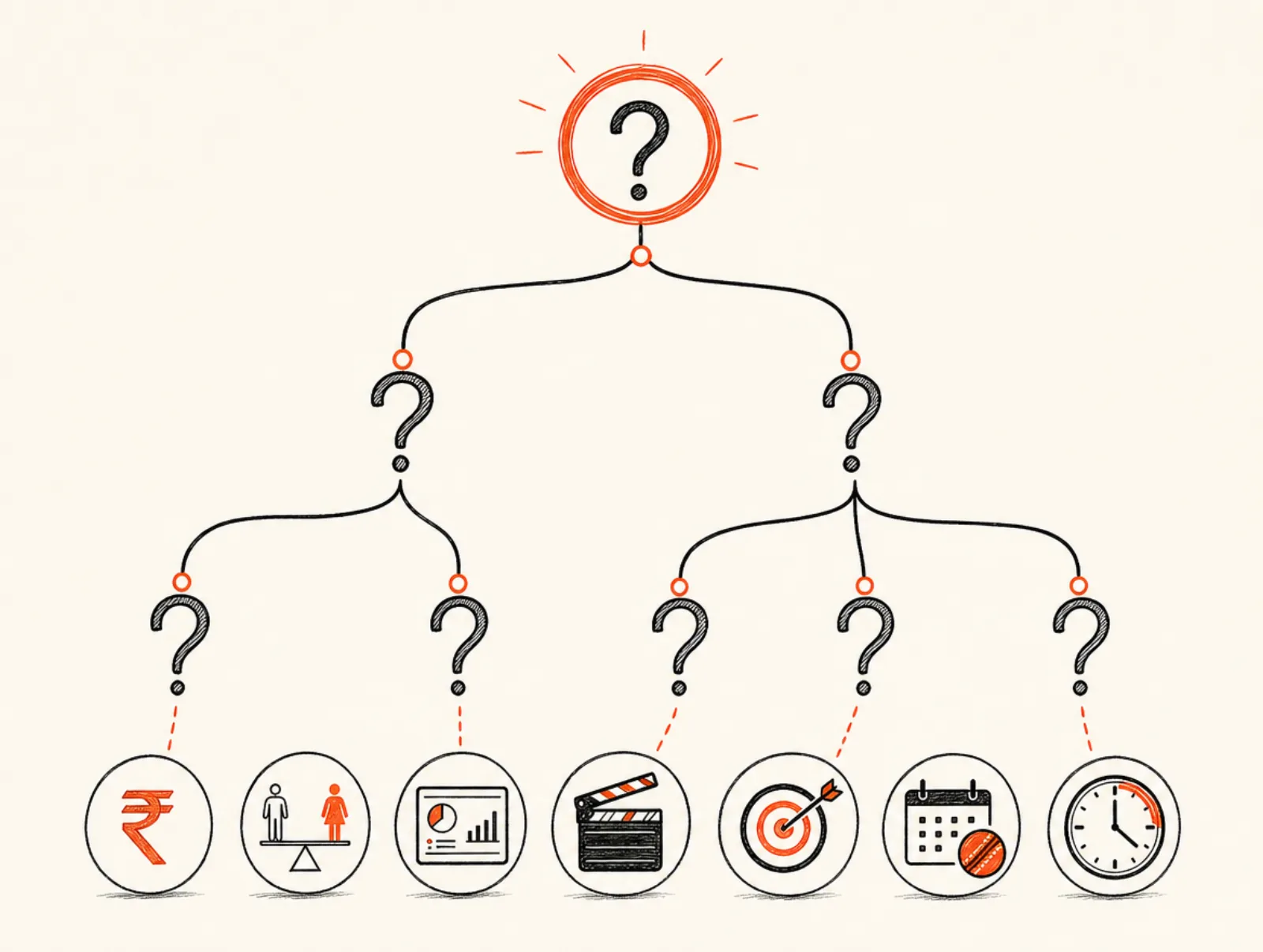
The 7-question framework: should you add JioStar to your stack?
We run this framework on any client considering a JioStar test. Answer each yes / no honestly. Five or more yes answers means JioStar is worth testing. Below that, budget is better deployed elsewhere.
1. Is your monthly Meta ad spend already above ₹5L with strong unit economics?
Below ₹5L/month Meta spend, you don't have budget elasticity to fund a meaningful JioStar test without starving Meta. “Strong unit economics” = CAC under 35% of AOV and blended ROAS above 2.5×. Without these, fix Meta first.
2. Does your audience skew female under-35?
If yes, JioStar sports inventory is a poor fit. Non-sport JioStar (drama, regional, Bollywood originals) has a more balanced audience but at premium OTT CPMs that compete poorly with Instagram for women-focused categories.
3. Do you have CAPI + Pixel + Shopify conversion tracking already wired up on Meta?
Without mature Meta attribution, adding JioStar cripples your ability to read what's working. The two channels' attribution maturities are too different to compare without clean Meta data as baseline.
4. Can you produce broadcast-quality 10–30 second creative within budget?
Repurposed vertical mobile UGC looks bad on JioStar. Plan ₹50,000–₹1,50,000 per asset (non-sport) and 2–4 assets per month minimum to fuel a test. If creative budget doesn't extend to this, stick with Meta.
5. Are you optimising for brand awareness or for performance ROAS?
JioStar buys awareness. Meta buys conversions. If your CFO / board / investor expects every rupee tied to a Shopify revenue line in a weekly dashboard, JioStar will lose every internal review regardless of whether it's working.
6. Do you have category-relevant content windows (cricket, drama, regional, Bollywood)?
Random JioStar buys without contextual alignment rarely pay off. Men's athleisure during cricket = aligned. Women's ethnic during regional Hindi drama = aligned. Generic non-premium runs across all inventory = burning money.
7. Can you wait 60–90 days for measurable brand-lift before judging the channel?
JioStar's impact shows up in branded search volume, direct-traffic Shopify sessions, and Meta retargeting CTR — all of which lag spend by 30–60 days. If finance will kill the budget after 30 days because in-platform ROAS looks weak, don't start.
Budget allocation — three D2C scenarios
Brand at ₹2L/month total ad spend
- Meta: ₹1,60,000 (80%)
- Google (Search + Performance Max): ₹40,000 (20%)
- JioStar: ₹0. Premature.
Compound on Meta + Google. Adding JioStar at this budget starves channels actually delivering Shopify revenue.
Brand at ₹5L/month total ad spend
- Meta: ₹3,50,000 (70%)
- Google: ₹1,00,000 (20%)
- JioStar non-premium: ₹50,000 (10%) — only if the brand passes 5+ of the 7-question framework, only as a brand-awareness test with proper measurement plan.
Plus ₹1–2L of creative production for the JioStar test. Run 90 days minimum. Measure brand-lift via branded search and direct traffic, not in-platform ROAS.
Brand at ₹20L/month total ad spend
- Meta: ₹13,00,000 (65%)
- Google: ₹4,00,000 (20%)
- JioStar (mix of premium and non-premium): ₹3,00,000 (15%) — including contextually-aligned premium buys where audience-content match is genuinely strong (men's athletic during IPL window, etc.)
At this scale you can also explore direct buys for masthead or L-band placements during marquee events for category-leadership positioning, separately from the performance budget.
FAQ
How much do JioHotstar ads cost in 2026?
JioStar's self-serve platform has no fixed minimum spend; practical campaign entry is around ₹4,000 per the platform's launch announcement. IPL 2026 CTV inventory runs ₹600–₹750 CPM (10-second base), mobile pre-roll ₹180–₹360, and CTV display ₹75–₹150. Non-premium entertainment slate CPMs are not publicly disclosed but triangulate to ₹250–₹500 based on comparable OTT inventory (SonyLIV, ZEE5). A realistic monthly minimum for meaningful test learning is ₹2,00,000.
What's the minimum budget to run JioHotstar self-serve ads?
JioStar markets the self-serve platform as having no fixed minimum, with campaigns startable from ₹4,000. In practice, you need ₹2,00,000+/month to buy enough impressions for a statistically meaningful read on creative and audience performance. Below ₹2L/month, the data won't tell you anything useful — you're paying for the experience, not learning.
How do you set up a JioHotstar self-serve ad campaign?
Through the JioStar Ads Manager dashboard (Google-Ads-style interface launched in 2025). You sign up with a business account, set a campaign objective (reach, video views, or signal-led commerce), pick inventory (sport, entertainment, drama, regional), choose audience filters (demographics + NCCS + region + Reliance commerce signals where available), upload creative (broadcast-quality 10–30s recommended), set CPM bid + daily budget, and launch. Approval typically 24–48 hours. Reporting refreshes daily.
Should D2C brands run JioHotstar ads?
It depends on scale and category. For D2C brands spending under ₹5L/month on Meta, JioStar is premature: the attribution infrastructure isn't there for Shopify-tracked performance ROAS, creative production cost is 5–10× higher, and the platform's IPL-and-sports skew (~75% male) is mismatched with women-focused categories. Brands spending ₹5L+/month with mature Meta CAPI tracking can productively test 5–10% of budget on JioStar for brand awareness — not as a Meta replacement.
Can you track Shopify conversions on JioHotstar ads the way you do on Meta?
Not in the same closed-loop way as of 2026. Meta's Pixel + Conversions API + Aggregated Event Measurement stack lets you attribute Shopify orders back to specific ad sets — even with iOS 14+ signal loss running 50–70% of mobile traffic. JioStar's measurement is currently signal-led via Reliance's commerce graph (JioMart, Instamart partnership), which is closed-loop within Reliance's stack but does not deterministically attribute to a Shopify storefront. Most JioStar campaigns are measured via brand-lift studies or MMM, not direct ROAS.
What ROAS can a D2C brand realistically expect from JioStar ads?
Honestly, direct-response ROAS is the wrong metric for JioStar in 2026. The platform's strength is reach and contextual brand association during high-attention events (IPL, WPL, marquee drama, regional content). For brands trying to compute a comparable number, expect 0.5×–1.5× in-platform attributed ROAS (low) but a measurable lift in branded Meta retargeting CTR and direct-traffic Shopify sessions over 60–90 days. JioStar buys awareness; Meta + Google convert it.
How does JioStar compare to Meta for women's fashion brands specifically?
Worse — at least for sports inventory. Nielsen Mobile OTT data shows JioHotstar's mobile audience skews ~75% male, concentrated in 25–34 age band, NCCS A/B/C, urban. For women's apparel, lingerie, or beauty-adjacent fashion brands, this is a material mismatch. Meta India's roughly balanced gender split + Instagram's fashion-discovery behaviour makes it categorically better for women-focused categories. JioStar's non-sport inventory (drama, regional, Bollywood) is more balanced but mid-tier OTT CPMs are still 1.5×–2.5× Meta's at lower attribution maturity.
What creative formats does JioHotstar accept, and how do they differ from Meta?
JioStar accepts pre-roll (6–60s), mid-roll (6–60s, non-skippable in live sports), display banners, non-skippable live-event spots, masthead takeovers, and CTV connected-TV formats. Practical production: 10s and 30s horizontal cuts, broadcast-quality, mastered in 1080p or 4K for CTV. This differs sharply from Meta's UGC-first, 6–15s, vertical, mobile-shot format. Most D2C brands need a separate creative pipeline for JioStar — repurposed Meta UGC reads as low-quality on a 55-inch screen.

How to use this playbook
If you're a D2C founder evaluating JioStar tomorrow:
Under ₹5L/month total ad spend: skip JioStar entirely. Compound on Meta. Add Google Performance Max once you cross ₹2L/month. Revisit JioStar when you cross ₹5L/month with mature attribution.
₹5L–₹10L/month and female-skewed category: skip JioStar for now. Audience mismatch is too costly. Invest the would-be JioStar budget into Instagram creator partnerships, Reels-first creative, and YouTube Shorts.
₹5L–₹10L/month and male-skewed / unisex category: run a 90-day JioStar non-premium test at 10% of budget. Set up brand-lift measurement (branded search, direct traffic, Meta retargeting CTR) before launch. Treat in-platform ROAS as directional, not decisional.
Above ₹10L/month: you can afford to test JioStar at scale. The right test isn't a single campaign — it's a quarterly budget line for contextual-aligned buys during marquee windows (IPL for athletic, marquee drama for premium, WPL for women's athletic). Measure via MMM or holdout studies, not in-platform attribution.
And if you've actually run a JioStar campaign for a D2C brand at scale, we'd love to learn from it. This playbook will be updated as new public data and case studies emerge. If you want a second opinion on integrating JioStar with an existing Meta + Google stack, see our performance marketing service — we run paid media for 120+ active D2C brands and can pressure-test whether a JioStar test makes sense for yours.
⏤ Free audit
Get a free audit in 5 working days.
Read-only access to your Meta + Google Ads accounts. Full teardown of wasted spend, creative fatigue, and ROAS forecast. No obligation.

⏤ Working on something similar?
Get a free audit in 5 working days.
Read-only access to your Meta + Google Ads accounts. Full teardown of wasted spend, creative fatigue, and ROAS forecast. No obligation. Or jump straight to our performance marketing page.